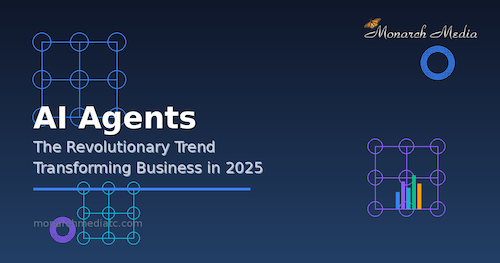
AI agents are no longer a future concept — they are already deployed across customer service, research, enterprise automation, and security at scale. This guide explains what they are, how they differ from chatbots, where they are being used, and how to approach implementation strategically.
🔑 Key Takeaways
- AI agents are autonomous systems that plan, reason, and complete multi-step tasks without constant human supervision
- The AI agent market is projected to grow from $5.1 billion to $47.1 billion — a 9x increase
- Companies earn an average $3.70 for every $1 invested in generative AI; top performers reach $10.30
- 41% of companies already use AI agents for customer service; 60% for IT help desks
- Data quality is the #1 implementation barrier — fix your data infrastructure before deploying agents
- 82% of companies plan to integrate AI agents within the next 1–3 years
What Are AI Agents and Why Are They Different?
Unlike traditional AI chatbots that simply respond to prompts, AI agents are autonomous systems capable of making decisions, executing complex tasks, and taking action without constant human supervision. These systems use large language models to determine the control flow of applications — enabling them to plan, reason through problems, and carry out multi-step workflows independently.
The key distinction lies in their autonomy and capability. While earlier AI tools required users to guide every interaction, AI agents can analyze situations, make informed decisions, and complete entire projects from start to finish. They are not just answering questions — they are actively solving problems and driving outcomes.
The simple distinction: A chatbot answers the question you ask. An AI agent figures out what questions to ask, does the research, makes decisions along the way, and delivers you a finished result — without you needing to supervise each step.
The Evolution from Chatbots to Autonomous Agents
The journey from simple chatbots to sophisticated AI agents represents one of the most significant leaps in artificial intelligence history. Companies that once relied on basic chatbots for customer inquiries now deploy AI agents that handle complex operations, strategic marketing decisions, and even participate in business planning.
Major technology companies have introduced groundbreaking agent frameworks in rapid succession. OpenAI released its Swarm framework, which enables AI agents to collaborate on tasks and manage their own operations. Anthropic launched Claude's Computer Use feature, allowing AI to interact with computers by looking at screens, moving cursors, and typing text — just like humans do. Google unveiled Mariner, an AI agent capable of browsing spreadsheets and shopping sites while taking action on behalf of users.
⚡ Key Capabilities Driving Agent Adoption
- Advanced reasoning: Agents solve intricate challenges in science, coding, mathematics, law, and medicine by breaking down problems and evaluating multiple solution pathways
- Multimodal understanding: Agents understand and generate text, images, and audio from single interfaces — eliminating the need for multiple specialized tools
- Interface automation: Agents navigate web browsers, operate desktop systems, and interact with software applications autonomously
- Multi-step planning: Unlike chatbots, agents decompose complex goals into sub-tasks and execute them in sequence with error-correction built in
Real-World Applications Transforming Industries
The practical applications of AI agents span virtually every industry sector, with adoption moving faster than most organizations anticipated.
of companies use AI agents for customer service
have implemented AI agents for IT help desks
deploy agents for research and summarization
average return per $1 invested in generative AI
Enterprise Operations and Productivity
In enterprise settings, AI agents are revolutionizing daily operations. Microsoft's Copilot Studio and frameworks like AutoGen enable businesses to build customized agents for specific workflows. These systems automate decision-making processes ranging from market analyses to e-commerce transactions, freeing human workers to focus on strategic initiatives requiring creativity and emotional intelligence.
LinkedIn's Hiring Assistant is a strong example of this transformation. This AI agent ingests hiring notes to create comprehensive job descriptions, sources qualified candidates, and engages with potential hires — tasks that traditionally required significant human time and effort per open role.
Research and Development Acceleration
Research and summarization represent a major use case, with 58% of surveyed organizations deploying agents for these purposes. Instead of manually reviewing extensive documentation, researchers now rely on AI agents to distill key insights from vast information volumes — compressing work that previously took weeks into hours.
Healthcare leads adoption: Healthcare organizations show the highest concentration of what researchers call "AI leaders" — organizations running multiple production-scale deployments. Mid-sized companies with 100–2,000 employees are the most aggressive, with 63% actively using agents in production.
The Technology Behind Agent Intelligence
The rapid advancement of AI agents stems from several technological breakthroughs. Foundation models are now being designed from the ground up with built-in capabilities for multi-step task decomposition, planning, tool use, and multimodal interactions. This represents a fundamental shift from retrofitting agent capabilities onto existing models.
Agent Frameworks and Development Tools
The democratization of agent development has played a crucial role in widespread adoption. Frameworks like AutoGen, CrewAI, LangGraph, and LlamaIndex have made AI agents accessible to both developers and non-technical users. These platforms provide templates, tools, and no-code options that allow anyone to build customized agents regardless of technical background.
Small language models have also emerged as significant enablers, making sophisticated AI features viable on devices as small as smartphones. Meta's Llama models have become four times faster and 56% smaller than earlier generations, while NVIDIA's Nemotron-Mini requires only about 2GB of memory — making agent technology far more widely deployable than it was even a short time ago.
Business Impact and ROI
average ROI per $1 spent on generative AI
ROI for top-performing organizations
average AI deployment timeline
of businesses now use generative AI (up from 55%)
The financial case for AI agent adoption is clear. Companies investing in generative AI see an average return of $3.70 for every dollar spent, with leading organizations reaching $10.30. Deployment timelines have also compressed significantly — AI deployments now take less than eight months on average, with measurable value typically realized within 13 months of launch.
Challenges and Considerations for Implementation
Despite promising returns, organizations face real barriers to effective AI agent deployment. Understanding these challenges before you start is the difference between a successful rollout and a costly failed experiment.
⚠️ Top Implementation Challenges
- Data quality (34%): The most common barrier — many organizations have data management infrastructure that is inadequate for effective agent deployment. Fix this first.
- Performance concerns (41%): The primary bottleneck to adoption. Agentic approaches don't fit every problem — sometimes simpler automation is more effective.
- Trust and oversight (57%): Industry executives acknowledge the need for robust safeguards. Agents make autonomous decisions that can significantly impact business outcomes.
- Skills gaps (30%): Organizations lack specialized AI skills in-house; 26% cite insufficient employees with skills needed to learn and work with AI.
Critical insight: 82% of companies plan to integrate AI agents within the next 1–3 years. The organizations that invest in data infrastructure and skills development now will have a significant head start over those scrambling to catch up later.
The Road Ahead: Multi-Agent Systems and Security
Experts predict several key developments as agent technology matures. Multi-agent systems will become more prevalent, with organizations deploying teams of specialized agents that collaborate on complex projects. Agent orchestration platforms will enable businesses to manage multiple agents working together, each contributing unique expertise to collective goals.
Security-focused AI agents are expected to play increasingly important roles in protecting data and detecting threats. Companies have already announced multi-AI agent security technology that coordinates multiple specialized agents to simulate cyberattacks and develop protection strategies — essentially using AI agents to defend against AI-assisted attacks.
Regulatory frameworks are also evolving to address agent deployment. Legislation in major markets aims to ensure safety and protect fundamental rights while encouraging innovation. Organizations scaling agent implementations need to stay current with compliance requirements, as the regulatory landscape is actively developing.
Getting Started with AI Agents
🚀 Practical Implementation Roadmap
- Identify specific use cases first: Customer service automation, research summarization, and repetitive workflow tasks are proven starting points with clear ROI
- Fix your data infrastructure: Quality data is the foundation — address data management, storage, and preprocessing gaps before deploying agents
- Start with established frameworks: AutoGen, CrewAI, LangGraph, and LlamaIndex offer templates and support that reduce the technical burden on internal teams
- Build internal capabilities in parallel: Invest in employee training and consider partnerships with educational institutions to address skills gaps
- Set realistic expectations: Not every problem requires an AI agent. Evaluate whether agentic approaches actually outperform simpler automation for each use case
- Plan for oversight from day one: Build human review checkpoints into agent workflows, especially for decisions that carry financial or reputational risk
The Bottom Line
AI agents represent far more than incremental improvement in artificial intelligence — they signify a fundamental transformation in how technology augments human capabilities. As autonomous systems that can reason, plan, and execute complex tasks independently, agents are reshaping industries from customer service to healthcare, from cybersecurity to research and development.
The market data tells a clear story: substantial growth projections, climbing deployment rates, and ROI figures demonstrating real business value. Yet success requires thoughtful implementation — addressing data quality challenges, setting appropriate performance expectations, and building the organizational trust that autonomous systems require.
Organizations that approach AI agents strategically — identifying appropriate use cases, investing in necessary infrastructure, developing internal capabilities, and maintaining realistic expectations — position themselves to capture what industry leaders consistently describe as a multitrillion-dollar opportunity. The agent revolution is not approaching; it is already underway. The question is not whether to adopt AI agents, but how effectively your organization can integrate them into operations to stay competitive as the technology continues to mature.