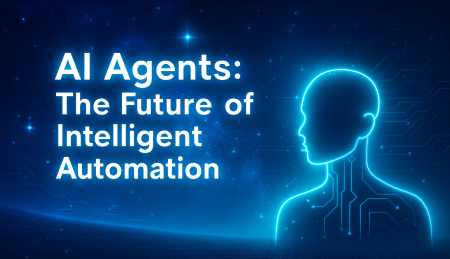
AI Agents: Your New Intelligent Teammates
Forget the headlines and hype cycles. The real story about AI agents is playing out inside organizations right now, quietly reshaping how work gets done. These systems are no longer confined to research labs or science fiction storylines — they're sitting alongside human teams, taking on complex workflows, and delivering measurable results for businesses of every size.
But what exactly is an AI agent? How does it differ from a simple chatbot or automation script? And more importantly, how can your organization actually put one to work? This guide cuts through the noise and gives you a clear-eyed look at what modern AI agents can do — and where they still fall short.
What Is an AI Agent?
An AI agent is a software system designed to perceive its environment, make decisions, and take actions in pursuit of specific goals — all with minimal human supervision. Unlike a basic chatbot that waits for a question and returns an answer, an agent operates proactively. It can plan a sequence of steps, use external tools, call APIs, browse the web, write and run code, and adjust its strategy based on what it learns along the way.
Think of the difference this way: a traditional automation tool does exactly what you tell it to do, step by step, in a pre-programmed sequence. An AI agent understands the objective you want to achieve and figures out the steps on its own. That shift — from instruction-following to goal-pursuing — is what makes agents genuinely new territory in the history of software.
If you've already explored AI assistants or experimented with an AI writing assistant, agents represent the natural next step forward. They don't just respond — they act.
Core Capabilities That Set Modern Agents Apart
When people first encounter AI agents, the feature that stands out is autonomy. But autonomy alone doesn't explain why these systems are so powerful. What makes them genuinely useful is how several distinct capabilities combine into something that behaves less like a program and more like a skilled collaborator.
Autonomous Decision-Making
Agents can evaluate options, weigh trade-offs, and execute tasks without waiting for human approval at every step. This makes them particularly valuable for high-volume, repetitive processes where constant oversight would create bottlenecks. A well-designed agent handles the routine and surfaces only the exceptions that genuinely need human judgment — freeing your team to focus on work that actually requires them.
Contextual Understanding
Today's agents don't just parse keywords — they interpret context. An agent reviewing customer support tickets can distinguish between a billing frustration and a product defect even when the customer's language is vague or emotionally charged. An agent monitoring social media can recognize when a shift in sentiment signals a real problem versus routine noise. This kind of nuanced reading of complex, unstructured data was previously a uniquely human skill.
Multi-Step Strategic Planning
Give an agent a goal, and it will break that goal into a sequence of smaller tasks, execute them in the right order, and manage dependencies along the way. This kind of planning was previously the exclusive domain of human project managers. Agents don't replace that judgment entirely, but they dramatically reduce the cognitive overhead involved in managing complex workflows. The result is faster execution with fewer dropped balls.
Memory and Continuous Improvement
Modern agents are increasingly equipped with memory systems that allow them to retain context across interactions. An agent that helped you structure a report last week can recall the format you preferred, the sources you found most credible, and the sections that needed the most revision. Over time, this produces something that feels less like querying a database and more like working with a teammate who actually pays attention.
Integration With Your Existing Tools
Agents don't operate in isolation. They connect to your CRM, email platform, project management software, databases, and APIs — coordinating actions across systems without you manually bridging them. This integration capability is what turns a capable AI into a genuine productivity multiplier rather than just another tab to manage.
The Five Major Types of AI Agents
Not all agents are built the same way, and understanding the differences helps you match the right architecture to the right problem. The field broadly recognizes five major agent types, each suited to different challenges.
Reactive Agents
Reactive agents respond to immediate inputs without maintaining a model of the world. They're fast and reliable for well-defined trigger-response scenarios: alerting when server load spikes, sending a notification when a form is submitted, flagging a transaction that matches a fraud pattern. Their simplicity is their strength — and their limitation. They don't plan ahead or learn from past events, which makes them excellent for narrow, clearly defined tasks but ineffective for anything that requires reasoning about consequences.
Model-Based Agents
Model-based agents maintain an internal representation of their environment, allowing them to simulate outcomes before acting. This makes them well-suited for testing and forecasting scenarios where the agent needs to reason about consequences. A model-based agent managing logistics, for instance, can predict how a delayed shipment will ripple through downstream fulfillment before deciding how to reroute it — rather than just reacting after the fact.
Goal-Oriented Agents
Goal-oriented agents are designed to achieve specific outcomes, evaluating multiple possible paths and choosing the one most likely to succeed. Rather than simply responding to current conditions, they stay focused on the end state. This makes them ideal for project-based work: drafting a go-to-market plan, completing a research synthesis, or managing a multi-phase content calendar from brief to published post.
Utility-Based Agents
Where goal-oriented agents pursue a single objective, utility-based agents optimize across competing priorities simultaneously. They assign value to different possible outcomes and choose actions that maximize overall benefit — even when those priorities are in tension. An agent managing a customer service queue, for example, might balance resolution speed, customer satisfaction scores, and agent workload all at once, dynamically adjusting assignments as conditions change throughout the day.
Learning Agents
Learning agents are the most sophisticated class. They don't just execute a fixed strategy — they update their behavior based on experience. Every interaction, every outcome, every piece of feedback makes them incrementally more effective. If you're looking for an agent that gets meaningfully better the longer you use it, a learning architecture is what you want. These systems are also the most resource-intensive and require careful design to ensure they're learning the right lessons from the right signals.
Where Organizations Are Deploying Agents Today
AI agents are no longer experimental technology. Across industries, organizations are putting them to work in specific, high-impact areas — and the results are giving early adopters a real edge.
Customer Experience
Intelligent support agents handle Tier 1 and Tier 2 customer inquiries around the clock, escalating only the cases that genuinely require human attention. They pull from knowledge bases, process account information, draft responses, and learn from each resolved ticket. The result is faster resolutions for customers and lower support costs for businesses — without sacrificing quality on complex interactions that still need a human touch.
Team Productivity and Administrative Workflows
From scheduling and meeting summaries to document generation and internal communications, agents are absorbing the administrative layer that historically consumed hours of productive time every week. Teams that have integrated agents into their workflows consistently report being able to focus more energy on strategic and creative work — the areas where human judgment adds the most value.
Content and Creative Production
Agents are reshaping content production pipelines. Paired with tools like an AI writing assistant, a production agent can manage the full arc of a content piece: researching a topic, generating a draft, running it through style and SEO guidelines, formatting for publication, and queuing it for review. Human editors stay in the loop for quality and voice, but the volume of work they can oversee multiplies significantly.
Data Analysis and Business Intelligence
Agents can continuously monitor datasets, detect anomalies, surface trends, and generate plain-language summaries — delivering the kind of ongoing analytical support that previously required a dedicated analyst. For businesses swimming in data but short on capacity to act on it, this capability alone can justify adoption. The agent never sleeps, never gets pulled onto another project, and never misses a pattern because it was having an off day.
Security and Compliance Monitoring
Security-focused agents watch for threats in real time, correlating signals across systems that no human team could monitor simultaneously. They flag suspicious patterns, trigger automated responses, log events for audit purposes, and escalate confirmed threats — compressing response times from hours to seconds in scenarios where every second matters.
Real Organizational Value: What Adoption Actually Delivers
Organizations that have deployed agents effectively report a consistent set of outcomes. Operational efficiency improves as teams shed the repetitive tasks that consumed their bandwidth. Decision quality rises as leaders access real-time analysis and pattern recognition that wasn't previously available to them. Scaling becomes less expensive — expanding capability no longer requires proportional headcount increases. And in competitive markets, the ability to move faster and with more precision creates advantages that compound over time.
None of these outcomes happen automatically. They require thoughtful implementation, clear use case selection, and ongoing governance. But for organizations that approach agents strategically, the returns are genuinely meaningful.
Navigating the Real Limitations
A clear-eyed view of AI agents has to include their limitations — and those limitations are real. Agents currently lack human emotional intelligence. They can recognize patterns in language that suggest frustration or urgency, but they don't actually understand what it feels like to be in those situations, which limits their effectiveness in high-stakes interpersonal contexts.
Ethical frameworks for agent behavior are still under active development. Questions about how agents should handle ambiguous instructions, conflicting priorities, or sensitive data don't yet have settled answers. Organizations deploying agents need to think carefully about governance rather than assuming the technology will sort it out on its own.
Computational requirements can also be substantial, particularly for sophisticated learning agents operating at scale. And performance can vary in unpredictable or rapidly changing environments — situations where the agent encounters conditions outside what it was trained to handle. Successful adoption requires realistic expectations, proper oversight, and the recognition that agents are designed to augment human judgment, not replace it.
What's Coming Next: The Multi-Agent Future
The next phase of AI agent development isn't about making individual agents smarter in isolation — it's about making them work together. Coordinated multi-agent ecosystems are emerging where specialized systems collaborate on complex initiatives, each handling the part of the problem it's best suited for and passing outputs to the next agent in the chain.
Imagine a research and strategy workflow where one agent gathers and synthesizes information, a second drafts strategic recommendations, a third formats the output for different stakeholder audiences, and a fourth schedules and distributes final deliverables — all with a human reviewer at key checkpoints. That kind of coordinated execution is becoming practical today, and organizations that build the infrastructure to support it will have a meaningful head start as the technology matures.
Deeper integration with cloud infrastructure will make deployment more seamless across the board. Industry-specific agent solutions tailored to the workflows and compliance requirements of sectors like healthcare, finance, and legal are accelerating. And enhanced transparency features — explainable decision-making that helps users understand why an agent took a particular action — are becoming a core expectation rather than a premium feature.
The organizations that will benefit most from this shift are the ones that start experimenting now, build internal familiarity with what agents can and can't do, and develop the governance frameworks that responsible deployment requires. The technology is ready. The question is whether the organization is.
To stay current on how these developments are reshaping digital work, explore more on our AI tools and innovation hub or see how AI assistants are already changing the way teams communicate, create, and compete.