How AI's Data Center Boom Could Send Silver Prices Soaring
The silver market has quietly entered one of its most compelling phases in decades. While most investors remain fixated on gold's rally past $4,000 per ounce, silver has been staging an even more dramatic performance, breaking through $64 in December 2025 to reach historic highs. What's driving this surge isn't speculation or monetary policy alone. It's the physical infrastructure behind artificial intelligence.
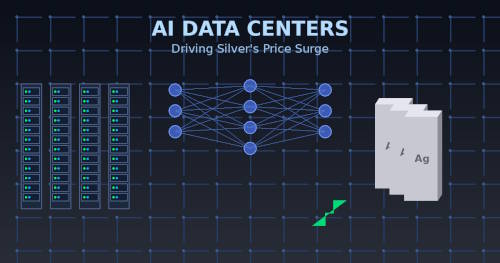
Data centers powering AI systems are consuming unprecedented amounts of critical materials, and silver—with its unmatched electrical conductivity—sits at the heart of this technological transformation. The convergence of this new demand source with an already strained supply chain is creating market dynamics that few anticipated even a year ago.
The Physics Behind the Demand
Silver's role in data center infrastructure isn't arbitrary. With electrical conductivity of 63 × 10^6 S/m, it outperforms every other metal on the periodic table. In applications where power density and reliability are paramount—exactly the conditions inside AI server farms—this physical property becomes non-negotiable.
An AI-focused data center requires two to three times the silver content of traditional facilities. The difference comes down to architecture. AI workloads demand higher power density, more sophisticated cooling systems, and vastly more interconnections between components. Each of these systems relies on silver's superior conductivity to function efficiently at scale.
Consider the scope: global IT power capacity in data centers expanded from less than 1 gigawatt in 2000 to nearly 50 gigawatts by 2025. Goldman Sachs projects that power demand from data centers will surge another 165% by 2030 as hyperscalers deploy AI clusters at unprecedented density. Every server, switch, and accelerator in these facilities incorporates silver in multilayer ceramic capacitors, circuit boards, and high-performance connections.
A Market Already Running on Empty
The AI boom isn't hitting a balanced market. Silver has been in structural deficit for five consecutive years, from 2021 through 2025. The cumulative shortfall has reached roughly 820 million ounces—equivalent to an entire year of global mine production.
This isn't cyclical tightness that will resolve with higher prices. Mine production peaked in 2016 at 900 million ounces and has been declining an average of 1.4% annually since then. For 2025, total mined output is projected at approximately 835 million ounces, still well below the 2016 peak despite silver prices having doubled over that period.
Why Supply Can't Respond
The muted supply response reveals a structural constraint that most commodity markets don't face. Between 70% and 80% of silver production comes as a byproduct of mining other metals—primarily copper, lead, and zinc. This means primary silver supply is largely determined by demand for base metals, not by silver prices alone.
Even dedicated silver miners face headwinds. Ore grades are declining at major deposits. Permitting timelines stretch across years. Capital requirements for new mines run into hundreds of millions of dollars. The development cycle from discovery to production typically spans 10 to 15 years. During silver's extended bear market from 2011 to 2020, exploration budgets dried up, leaving today's project pipeline notably thin.
Mexico, the world's largest silver producer, expects output to reach approximately 186 million ounces in 2025. While that represents growth from operations like Juanicipio and recovery at facilities like Peñoles following operational challenges, it's nowhere near sufficient to close the supply gap. Other major producers like Peru face declining output from aging base metal operations.
Industrial Demand Reaches Record Territory
Against this constrained supply backdrop, industrial consumption hit 680 million ounces in 2024 and is projected to reach new records in 2025. Solar photovoltaics remain the single largest growth driver, now accounting for 29% of industrial silver demand compared to just 11% in 2014.
But AI infrastructure represents a newer, compounding force. The semiconductor market—driven substantially by AI chip production—reached $688 billion in 2024, up 13% from the prior year. Silver consumption in this sector continues climbing as AI server deployments accelerate globally.
The electric vehicle transition adds another layer of demand. Silver is critical in battery management systems, power electronics, and charging infrastructure. With global EV sales hitting an estimated 17 million units in 2024, automotive silver demand is projected to grow 40% over the next decade. By 2027, EVs are expected to surpass internal combustion vehicles as the primary source of automotive silver consumption.
Data Center Demand Hits Critical Mass
What makes the data center sector particularly significant is its trajectory. Market analysts estimate that by 2025, one-third of all new computing capacity globally will be dedicated to AI workloads. These aren't marginal additions to existing infrastructure—they're massive new facilities consuming materials at unprecedented rates.
The United States alone could see data centers consuming 12% of total electricity by 2028, up from 4% in 2024. Each hyperscale facility under construction is expected to use as much power as 100,000 households, with the largest consuming 20 times that amount. All of this infrastructure requires the silver-intensive components that make high-density computing possible.
Even a conservative estimate suggests impact: if just 10% of new global data centers integrate silver-enhanced components in their power and cooling systems, industrial silver demand could rise 5% to 10% over the next decade. For a metal already experiencing five consecutive years of supply deficits, that's a meaningful structural shift.
Investment Flows Amplify the Squeeze
Physical scarcity is one thing. When investment demand piles onto an already tight market, price action can accelerate rapidly. Silver-backed exchange-traded products recorded holdings increases of approximately 18% through early November 2025, adding roughly 187 million ounces. That's more metal than the entire annual deficit—pulled out of circulation and locked into investment vehicles.
In October 2025, the London Bullion Market Association's vaults experienced a liquidity crisis. Holdings had fallen from 31,023 metric tons in June 2022 to 22,126 metric tons by March 2025—the lowest level in years. The squeeze became so acute that overnight borrowing costs to close short positions spiked to 200% on an annualized basis. Some traders had to transport silver by air freight rather than cargo ships to meet delivery obligations.
This dual demand—industrial users needing physical metal for production and investors seeking exposure to the price rally—is draining the marginal supply that typically buffers markets during periods of tightness.
Strategic Recognition Changes the Calculus
In 2025, the U.S. Department of the Interior added silver to its official list of critical minerals. This designation carries weight beyond symbolism. It unlocks policy mechanisms designed to secure domestic supply chains, including expedited permitting for mining projects, tax incentives, and potential federal stockpiling programs.
The timing reflects a broader recognition that silver isn't just a precious metal—it's industrial infrastructure for the green energy transition and digital economy. Countries worldwide are racing to build AI capacity, expand renewable energy, and electrify transportation. All three sectors are silver-intensive.
When governments begin treating a commodity as strategically essential, market dynamics shift. Competition for supply intensifies. Long-term purchasing agreements become more common. Stockpiling accelerates. These aren't speculative behaviors—they're rational responses to genuine scarcity.
The Gold-Silver Ratio Tells a Story
One metric that market participants watch closely is the gold-silver ratio—how many ounces of silver it takes to buy one ounce of gold. Historically, this ratio averages around 69:1. As recently as early 2025, it stood near 79:1, suggesting silver was undervalued relative to gold.
Silver's 128% year-to-date surge through late 2025 has narrowed this ratio substantially. While gold's institutional-driven rally to $4,000 captured headlines, silver quietly outperformed on a percentage basis. This relative strength reflects the dual nature of silver's market—it responds to both monetary factors that drive precious metals broadly and the specific industrial fundamentals that are unique to silver.
Looking Forward: Structural, Not Cyclical
Price forecasts for silver vary, but the directional consensus is clear. Bank of America raised its 12-month target to $65 per ounce. ING projects $55 per ounce by 2026. More aggressive scenarios envision tests of $80 to $100 per ounce between 2027 and 2028, driven by what analysts describe as a "brick wall" of intensifying supply-demand imbalance.
What makes these projections credible isn't speculation about monetary policy or currency debasement. It's arithmetic. The drivers are structural and unlikely to abate. AI infrastructure deployment is accelerating, not plateauing. Solar installations continue setting records. Electric vehicle adoption is still in early stages globally. Each of these trends is multi-year, potentially multi-decade in duration.
Meanwhile, the supply response remains constrained by geology, capital availability, and time. New mines take years to develop. Byproduct silver production moves with base metal demand, not silver prices. Recycling provides some relief but not nearly enough to close a deficit measured in hundreds of millions of ounces.
The Intersection Point
Markets occasionally reach inflection points where multiple forces converge. Silver appears to be at one of those junctures. The metal's unique physical properties make it indispensable for the technological infrastructure being built today. Its supply is constrained by factors that higher prices alone cannot quickly resolve. And demand is growing across multiple sectors simultaneously, each representing structural rather than cyclical consumption.
The AI revolution requires physical infrastructure at massive scale. That infrastructure is materials-intensive, power-hungry, and technologically demanding. Silver sits at the nexus of these requirements—neither too expensive to use nor possible to substitute without performance degradation.
For investors, commodities traders, and technology companies alike, understanding this dynamic matters. The next generation of AI capabilities won't be built in software alone. They'll be constructed in data centers, powered by electrical systems, and connected through networks—all of which depend on a white metal that's becoming harder to find and more critical to secure.
Whether silver reaches $75, $100, or higher in the coming years will depend on how quickly AI deployment accelerates, how severe the supply constraints become, and how investment flows respond to changing fundamentals. But the underlying thesis is straightforward: the digital transformation everyone's talking about requires real, physical materials. And one of the most important is already in short supply.