Smart Classrooms: How AI Is Changing Education
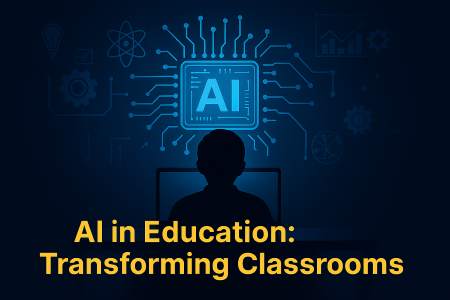
Something significant is happening in classrooms around the world — and it's moving faster than most people realize. Artificial intelligence is no longer a futuristic concept sitting outside the school walls. It's already inside them, reshaping how students learn, how teachers teach, and how schools operate. The question for educators, administrators, and parents isn't whether AI will affect education. It already has. The question is how to engage with it thoughtfully.
This guide covers the five most important ways AI is transforming education right now: personalized learning, teacher support, accessibility, virtual tutoring, and the ethical considerations that responsible adoption requires. Whether you're an educator exploring new tools or a parent trying to understand what your child's classroom will look like in five years, this is where the conversation starts.
Personalized Learning: Education That Adapts to the Student
Traditional classroom instruction operates on a fundamental compromise. A teacher stands in front of a room of thirty students with thirty different knowledge levels, learning styles, and paces — and tries to reach all of them with a single lesson. Some students are bored because they already understand the material. Others are lost because the lesson moved past them before they had a chance to catch up. The rest are somewhere in between.
AI-powered adaptive learning platforms break that compromise. Instead of delivering the same content to every student at the same pace, these systems continuously assess where each learner is and adjust accordingly. A student who demonstrates mastery of a concept moves forward immediately. A student who's struggling gets additional practice, a different explanation, or a more foundational review — automatically, without waiting for the teacher to notice and intervene.
The results are measurable. Research from MIT and Stanford has shown that AI-driven learning platforms can improve knowledge retention by up to 30% compared to traditional instructional methods. Platforms like Duolingo use this approach for language learning, dynamically adjusting vocabulary drills and grammar exercises based on performance data from hundreds of millions of users. Khan Academy's AI tutoring features provide real-time hints and adaptive problem sets that meet students where they are rather than where the curriculum assumes they should be.
Usage data reflects how widely students have embraced these tools. Recent surveys indicate that 86% of students globally use multiple AI tools for learning, with 54% reporting daily or weekly use. That's not a niche adoption curve — that's a generational shift in how learning happens outside the classroom.
What Personalized Learning Actually Looks Like in Practice
In a classroom using adaptive learning tools, two students working on the same math unit might be solving completely different problem sets — one reinforcing fractions because the assessment identified a gap, the other working on word problems that extend the concept into more complex applications. Both are engaged with material calibrated to their current level. Neither is bored. Neither is left behind.
For teachers, this creates an opportunity rather than a threat. The platform handles the differentiation that would otherwise require hours of lesson planning per student. The teacher's attention can shift to the students who need direct conversation, emotional support, or conceptual guidance that no algorithm can provide.
Teacher Support: Reducing the Burden, Restoring the Focus
Ask any teacher where their time goes and the answer is rarely "teaching." It's grading. It's scheduling. It's administrative paperwork, progress reports, parent communications, and lesson planning for differentiated instruction. A Carnegie Learning survey of 650 educators found that 65% already use AI tools for academic work, with the majority citing time savings as the primary benefit. That figure is only going to grow.
AI is particularly effective at automating the parts of teaching that are necessary but don't require human judgment. Grading objective assessments — multiple choice, fill-in-the-blank, short-answer responses that follow predictable patterns — is well within the capability of current AI systems. Platforms like Gradescope use machine learning to grade assignments quickly and consistently, flagging unusual responses for human review while handling the bulk of the workload automatically.
Beyond grading, AI tools are helping teachers with curriculum planning, identifying which students need intervention before they fall too far behind, generating draft lesson plans for review, and managing the logistical overhead of running a classroom. None of these tasks require the deep human expertise that makes a great teacher irreplaceable — but collectively, they consume enormous amounts of time that could be spent on exactly that expertise.
AI as a Teaching Partner, Not a Replacement
The concern that AI will replace teachers misunderstands what teaching actually is. What AI is doing — and what it's well-suited to do — is handle the administrative and repetitive dimensions of the job so that teachers can spend more time on the parts that actually require them: building relationships with students, providing emotional support, facilitating discussions, offering nuanced feedback on complex work, and creating the kind of classroom culture that data systems can't generate.
The schools getting the most value from AI tools aren't treating them as substitutes. They're treating them as infrastructure — the same way schools treat textbooks, projectors, or learning management systems. The infrastructure handles logistics. Teachers handle learning.
Accessibility and Inclusion: Reaching Every Learner
One of the most meaningful — and underreported — applications of AI in education is its potential to make learning accessible to students who have historically been underserved by traditional classroom formats. AI-powered tools are removing barriers that have kept certain students from fully participating in education for decades.
Speech-to-text technology allows students with hearing impairments or motor disabilities to engage with written content and contribute to classroom discussions in ways that weren't previously possible. Real-time translation tools are breaking down language barriers in increasingly diverse classrooms, allowing students who don't speak the dominant language of instruction to follow along, participate, and learn without waiting for a human interpreter. Text-to-speech systems are giving visually impaired students access to digital reading materials that were previously inaccessible.
Schools in South Africa have implemented AI-powered text-to-speech systems specifically to support visually impaired students, providing access to a full digital curriculum rather than a limited subset of materials available in Braille. Similar initiatives are underway in schools across Southeast Asia, Latin America, and parts of Europe, using AI translation to serve immigrant and refugee student populations who arrive with limited proficiency in the local language.
Immersive Technology and Engagement
AI-powered immersive technologies — augmented reality and virtual reality learning environments — are showing strong engagement results, particularly for students who struggle with traditional text-heavy instruction. Survey data indicates that 97% of students report being more likely to take courses that incorporate AR or VR experiences. For students with attention challenges, kinesthetic learning preferences, or low engagement with conventional materials, immersive AI tools represent a genuinely different way to experience and retain content.
The accessibility implications extend beyond students with diagnosed disabilities. Students in under-resourced schools — those without access to well-stocked libraries, experienced tutors, or enrichment programs — can access AI-powered learning tools that partially close the gap between what affluent and under-resourced schools can offer. That's not a complete solution to educational inequality, but it's a meaningful contribution to it.
AI-Powered Virtual Tutors: Learning Support Without Limits
One of the persistent inequities in education is access to tutoring. Students from families with financial resources can hire subject-matter tutors to help them through difficult material. Students without those resources are largely on their own. AI-powered virtual tutors are changing that equation in ways that would have seemed implausible a decade ago.
Modern AI tutoring systems can engage students in back-and-forth dialogue about academic content, explain concepts multiple ways when the first explanation doesn't land, walk through problem-solving processes step by step, and provide immediate feedback on practice work — all on demand, at any hour, without the cost of a human tutor. A student struggling with algebra at 10 PM on a Sunday before a Monday exam now has access to patient, knowledgeable help that wasn't available before.
The impact is measurable. A U.S. high school that implemented AI tutoring support reported a 20% reduction in homework completion gaps among struggling students — a group that was previously falling behind not because of inability, but because they lacked access to help outside of classroom hours. That's a real outcome for real students who were being left behind by a resource gap rather than a capability gap.
How Virtual Tutors Complement Human Teachers
Virtual tutors work best as a complement to human instruction, not a substitute for it. They're effective at reinforcement: explaining a concept the teacher introduced in class, providing additional practice on a skill the student hasn't mastered yet, helping a student prepare for a test by reviewing material systematically. What they can't do is replace the mentorship, motivation, and relational trust that a great teacher provides.
The most productive framework is one where AI tutors handle the practice and reinforcement layer — the work that benefits from repetition, patience, and availability — while human teachers focus on the conceptual introduction, the facilitated discussion, and the individual relationships that make the learning stick in the long run. To explore the tools that make this possible, see our overview of the best AI assistants available for educational use.
The Market Is Growing — and So Are the Stakes
The numbers behind AI in education reflect how seriously the industry is taking this transition. The global AI in education market was valued at approximately $7.71 billion in 2025 and is projected to reach $32.27 billion by 2030 — a compound annual growth rate of 31.2%. That's not marginal growth. That's a fundamental reshaping of the market for educational technology.
The growth is being driven by several converging factors. Computing costs are falling, making AI-powered tools accessible to schools that couldn't have afforded them five years ago. The quality of large language models has improved dramatically, making AI tutors and assistants more genuinely useful. And the COVID-19 pandemic accelerated institutional comfort with technology-mediated learning in ways that didn't fully reverse when schools reopened.
For educators and administrators, the growth trajectory has a practical implication: the tools available today are significantly less capable than the tools that will be available in three to five years. Schools that start building familiarity with AI now — understanding what it does well, where it falls short, and how to integrate it responsibly — will be better positioned to adopt future capabilities than schools that wait.
Navigating the Ethical Dimensions
The benefits of AI in education are real, but they don't arrive without complications. Any serious conversation about AI in classrooms has to include the ethical dimensions that responsible adoption requires.
Student Data Privacy
AI learning systems generate detailed data about student performance, behavior, and learning patterns. That data is valuable for improving outcomes — but it also creates significant privacy risks. Students are minors. The data being collected about them is sensitive. Schools and vendors have an obligation to handle it with appropriate care, which means strong data governance policies, transparent communication with parents, and vendor contracts that clearly limit how student data can be used.
In the United States, the Family Educational Rights and Privacy Act (FERPA) provides some baseline protection, but the regulatory framework for AI specifically is still catching up with the technology. Schools should not wait for regulation to address privacy — they should be ahead of it.
Algorithmic Bias and Equity
AI systems are trained on historical data, and historical data reflects historical inequities. An AI system that assesses student performance and makes recommendations about learning pathways can inadvertently encode biases — steering students from certain demographic groups toward lower-track material based on patterns in the training data rather than the actual capabilities of the individual student. This is not a hypothetical concern. It's a documented phenomenon in AI systems across multiple domains.
Schools adopting AI tools need to actively monitor for bias in outcomes across demographic groups, demand transparency from vendors about how their models were trained, and maintain human review of any AI recommendations that affect student placement or advancement. AI should expand opportunity for every student — if it's narrowing opportunity for some, that's a failure that needs to be addressed, not accepted.
Keeping Teachers in the Loop
The goal of AI in education should be to make teachers more effective, not to make them redundant. Schools that deploy AI in ways that reduce teacher involvement — shrinking classroom time, replacing human feedback with automated feedback across the board, or treating AI-generated lesson plans as finished products — are likely to see worse outcomes than schools that treat AI as a tool in the teacher's hands rather than a substitute for the teacher.
The research on what makes learning effective consistently points to the teacher-student relationship as a central variable. AI can support and enhance that relationship. It can handle logistics, provide practice, expand access. But the relationship itself is irreplaceable, and educational technology that loses sight of that will underdeliver on its promise.
What Schools Should Do Now
For schools and educators looking to engage with AI responsibly, the path forward doesn't require waiting for perfect tools or complete regulatory clarity. It requires starting with clarity about purpose: what specific problem are you trying to solve, and is AI actually the right solution to it?
Start with tools that address clear, bounded problems — reducing grading time, providing after-hours tutoring support, making materials accessible to students with disabilities. Evaluate outcomes deliberately: are students learning more? Are teachers spending more time on high-value work? Are accessibility gaps closing? Build governance before scaling: establish data privacy policies, communicate transparently with parents, and create oversight mechanisms for AI-generated recommendations before they affect student outcomes at scale.
The schools that will get the most from AI aren't the ones that adopt the most tools the fastest. They're the ones that adopt the right tools, for the right purposes, with enough oversight to catch problems before they compound.
For more on the AI tools reshaping professional and educational work, explore our full resource library on the Monarch Media TC homepage, or see how AI writing assistants are helping educators create better instructional materials in less time.