AI Music Generator: How to Create Custom Royalty-Free Soundtracks
Music and sound design transform content from ordinary to extraordinary, setting mood, enhancing emotional impact, and creating professional polish that distinguishes exceptional content from amateur productions. For decades, content creators faced a challenging dilemma: use expensive licensed music with copyright restrictions, compromise with limited royalty-free libraries, or produce without music entirely. AI music generators have fundamentally changed this landscape, enabling creators to generate custom, royalty-free soundtracks tailored precisely to their content needs without copyright concerns or budget constraints.
The Copyright Challenge in Content Creation
Traditional music licensing creates significant obstacles for content creators. Popular commercial music costs hundreds or thousands of dollars per license, pricing small creators out of the market. Even with licensing, restrictions often limit usage to specific platforms, timeframes, or audience sizes. Violating these terms—intentionally or accidentally—exposes creators to copyright strikes, content takedowns, and potential legal liability.
Royalty-free music libraries partially solved this problem but introduced new limitations. Generic stock music lacks distinctiveness, creating a "stock music sound" that audiences recognize as low-budget. Limited library selections mean the same tracks appear across countless videos, undermining content uniqueness. Even royalty-free libraries require careful attribution and usage restriction compliance, creating ongoing administrative burden for creators managing multiple projects.
Content creators previously faced three unsatisfactory options: pay substantial licensing fees limiting profitability, accept generic stock music compromising production quality, or forgo music entirely sacrificing emotional impact. AI music generation offers a fourth option that resolves these trade-offs: custom, royalty-free soundtracks generated on-demand to match specific creative visions without copyright concerns or budget constraints.
How AI Music Generators Work
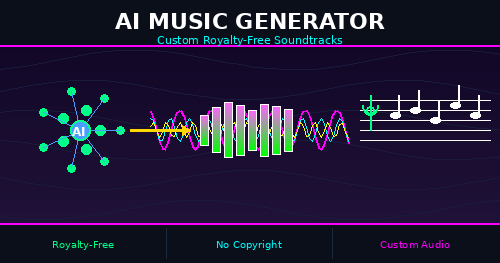
AI music generators analyze millions of songs to understand musical patterns, structures, and relationships between elements like melody, harmony, rhythm, and instrumentation. These systems don't simply remix existing music—they generate novel compositions based on learned patterns from their training data. The result is original music that sounds professional and stylistically consistent while being completely unique and copyright-free.
Most AI music generator platforms accept text descriptions or style parameters as input: "upbeat electronic music with driving beat suitable for workout videos" or "gentle acoustic guitar with warm, contemplative mood for meditation content." Advanced systems allow more granular control over tempo, key, instrumentation, song structure, and emotional tone. Some platforms even generate music from hummed melodies or reference tracks, creating variations that capture desired feelings while remaining legally distinct compositions.
Generation speed represents a dramatic advantage over traditional composition. While human composers might spend hours or days creating custom soundtracks, AI music generators produce complete tracks in seconds or minutes. This speed enables experimentation—creators can generate dozens of variations until finding the perfect match for their content without incurring additional costs or scheduling delays. Our music creator tool comparison showcases leading platforms offering these capabilities.
Best AI Music Generator Applications for Content Creators
YouTube creators represent perhaps the largest beneficiary of AI music generation. Background music enhances video engagement, but copyright strikes devastate channels through demonetization, content removal, or even channel termination. YouTube's Creator Academy emphasizes the importance of using copyright-safe music. AI-generated music eliminates these risks entirely while enabling perfect customization to video content, pacing, and emotional arc. Creators can generate distinct themes for different video series, establishing audio branding that audiences recognize and associate with their content.
Podcast producers increasingly use AI music generators for intro themes, outro music, and segment transitions. Custom music strengthens podcast branding while avoiding the licensing complexities that plague shows using commercial tracks. AI generation enables seasonal variations—holiday-themed intros, special episode music, or evolving themes that keep audio fresh across hundreds of episodes without budget impact or legal concerns.
Social media content demands music that captures attention instantly in cluttered feeds. TikTok, Instagram Reels, and YouTube Shorts all rely heavily on audio to drive engagement. AI music creators generate short-form audio perfectly timed to social video requirements, with hooks that grab attention in the first seconds. Creators can produce distinct audio identities across platforms without copyright complications or restriction on usage growth as videos go viral.
Game Development and Interactive Media
Independent game developers historically struggled with music budgets that compete with programming and art resources. AI music generators enable indie developers to create diverse, high-quality soundtracks rivaling those of larger studios. Adaptive music systems that respond to gameplay—intensifying during combat, softening in exploration, celebrating victories—become economically viable when AI generates the diverse musical variations these systems require.
Interactive media applications extend beyond gaming. Educational content, training simulations, virtual reality experiences, and interactive marketing all benefit from custom music that enhances engagement without licensing restrictions. AI music enables these applications to include sophisticated audio design that was previously financially impractical for most developers and content creators.
Quality Considerations and Limitations
AI-generated music quality has improved dramatically but varies significantly between platforms and price tiers. Premium AI music generator services produce outputs comparable to mid-tier stock music libraries—professional, polished, and suitable for commercial content. Free or entry-level services often generate simpler compositions with occasional artifacts or unnatural transitions. Understanding these quality differences helps creators select appropriate tools for their quality standards and budget constraints.
Musical complexity limitations exist in current AI systems. While AI excels at generating background music, ambient soundscapes, and genre-typical compositions, it struggles with highly nuanced performances, complex orchestral arrangements, or innovative compositions that break musical conventions. Human composers still dominate applications requiring musical sophistication, emotional subtlety, or boundary-pushing creativity that defines top-tier professional music.
Style consistency can vary between generations. Even with identical prompts, AI might produce somewhat different tracks across multiple attempts. This variability sometimes benefits creators seeking options but complicates applications requiring precise consistency—like generating additional episodes for established podcast themes. Most platforms address this through "seed" controls that enable generating variations on specific outputs, maintaining stylistic consistency across multiple tracks.
Legal and Copyright Clarity
AI-generated music typically comes with clearer copyright terms than traditional music. Most AI music platforms grant commercial usage rights to generated tracks, either through subscription fees or per-track pricing. According to the U.S. Copyright Office, understanding digital content rights is essential for creators. These terms eliminate the attribution requirements, territorial restrictions, and duration limitations that complicate traditional licensing. Creators own generated music outright, free to use across platforms indefinitely without ongoing royalty obligations.
Copyright clarity extends to platform policies. YouTube, TikTok, Instagram, and other major platforms recognize AI-generated music as creator-owned content, eliminating copyright claim risks that plague videos using commercial music. This policy clarity provides confidence that content won't face surprise takedowns or demonetization months after publication, protecting both immediate and long-term content value.
However, creators should verify specific platform terms before commercial usage. While most AI music services grant broad commercial rights, some free tiers or promotional access may carry restrictions. Review licensing agreements carefully, particularly for high-stakes commercial applications, sponsored content, or projects with significant monetary investment where copyright disputes would cause substantial damage.
Workflow Integration and Production Efficiency
AI music generators integrate smoothly into modern content production workflows. Most platforms offer browser-based interfaces requiring no software installation, enabling music generation from anywhere during production processes. Generated tracks download in standard audio formats (MP3, WAV, FLAC) compatible with all video editing software, audio workstations, and content management systems.
Some advanced AI music generator platforms integrate directly with video editing software, enabling music generation without leaving editing environments. These integrated workflows reduce friction between music selection and video editing, encouraging experimentation and refinement until achieving perfect synchronization between visual and audio elements. Direct integration also simplifies length customization—generating or trimming tracks to match exact video durations without manual audio editing.
Batch generation capabilities enable creating comprehensive music libraries for ongoing content needs. Creators can generate dozens of thematically consistent tracks for video series, establishing distinct audio identities while maintaining variation that prevents audience fatigue. This approach builds renewable music assets that serve multiple projects without ongoing generation time or costs per video.
Cost-Benefit Analysis
AI music generation pricing varies from free tiers with usage limits to premium subscriptions costing $10-100+ monthly. Free services typically allow limited monthly generations, lower audio quality, and restricted commercial usage. Mid-tier subscriptions ($15-30/month) provide unlimited generations, commercial licensing, and higher audio quality suitable for most content applications. Premium tiers offer advanced features like stem separation, longer track lengths, and custom model training on specific musical styles.
Compare these costs to traditional alternatives: hiring composers costs hundreds to thousands per track, while comprehensive stock music libraries charge $15-50 monthly for access to existing catalogs with attribution requirements and potential copyright complications. For creators producing multiple videos monthly, AI music generators deliver superior value through unlimited custom creation without copyright concerns or creative limitations of stock libraries.
The cost advantage multiplies for high-volume content production. Creators publishing daily content would need extensive stock music libraries or prohibitive composer budgets using traditional approaches. AI music generation enables these creators to generate fresh, distinct audio for every video without incremental costs beyond fixed subscription fees. This scalability particularly benefits growing creators whose content volumes increase but whose monetization hasn't yet justified substantial music budgets.
Creative Control and Customization
Modern AI music generator platforms offer unprecedented creative control through detailed parameter specification. Creators can define instrumentation—acoustic guitar, electronic synthesizers, orchestral strings, or hybrid combinations. Tempo controls enable matching music energy to content pacing, from slow contemplative pieces to high-energy tracks driving workout videos or action sequences. Mood descriptors guide emotional tone—happy, melancholic, mysterious, triumphant—ensuring musical emotion aligns with content messaging.
Song structure customization creates professional polish. Specify intro lengths, verse-chorus patterns, build-ups to climactic moments, and outro fades that match video structure. Some platforms visualize musical structure during generation, enabling precise alignment with video edits before export. This structural control ensures music supports storytelling rather than competing with or undermining narrative flow.
Advanced users leverage stem separation features that export individual instrumental layers—drums, bass, melody, harmonies—as separate audio files. This separation enables granular mixing within video editing software, adjusting relative volumes, muting elements during dialogue sections, or creating dynamic soundscapes that evolve with video content. Stems also enable remixing existing tracks into variations for related content, maintaining audio brand consistency while preventing repetition.
Ethical Considerations and Industry Impact
AI music generation raises questions about impact on human musicians and composers. Some view AI as threatening livelihoods of working musicians, particularly those creating stock music or low-to-mid-tier commercial compositions. Research from Berklee College of Music explores how technology is reshaping the music industry. Others argue AI democratizes music creation, enabling individuals and small businesses to include professional audio in their content without budgets previously requiring specialized musical talent.
The reality appears more nuanced. AI music particularly affects lower-budget stock music markets where creators previously used generic library tracks. High-end commercial music production, innovative composition, live performance, and music requiring emotional nuance remain dominated by human musicians. AI creates new opportunities while disrupting others—shifting where musical value lies within the industry rather than eliminating human musicianship entirely.
Transparent attribution practices help creators use AI music ethically. While legal requirements rarely mandate disclosing AI-generated music, some creators choose transparency about their production tools. This disclosure builds audience trust while setting realistic expectations about production values. As AI generation becomes ubiquitous, such transparency may become standard practice similar to disclosing other production tool choices.
Future Developments and Emerging Capabilities
AI music technology continues advancing rapidly. Emerging capabilities include real-time generation that adapts music dynamically based on video content analysis, creating perfectly synchronized soundtracks automatically. Emotional analysis systems that detect content sentiment and generate matching musical moods promise to further automate music selection while maintaining emotional coherence between audio and visual elements.
Voice synthesis integration represents another frontier—AI systems that generate not just instrumental music but also vocals, creating custom songs with lyrics, melodies, and sung performances. These capabilities enable content creators to produce complete original music including vocal elements without hiring singers or licensing vocal tracks. Lyric generation AI combined with vocal synthesis could enable fully automated custom song creation from text descriptions alone.
Collaborative AI systems that enable iterative refinement through natural language feedback will make AI music more accessible to non-musicians. Rather than understanding musical terminology, creators could request "make it more intense," "add piano," or "speed it up slightly" and receive instantly modified versions. This conversational interaction removes remaining technical barriers to effective AI music utilization.
Frequently Asked Questions About AI Music Generators
Is AI-generated music royalty-free?
Most AI music generator platforms grant full commercial usage rights to generated tracks through their subscription or per-track pricing. This means you own the music and can use it across any platform without ongoing royalty payments. However, always verify the specific licensing terms of your chosen platform, as free tiers may have restrictions on commercial usage.
What is the best AI music generator?
The "best" AI music generator depends on your specific needs. For beginners, platforms like Soundraw and AIVA offer user-friendly interfaces. Professional creators often prefer Mubert or Boomy for advanced customization. YouTube creators benefit from platforms that explicitly grant YouTube monetization rights. Check our comprehensive comparison to find the best match for your requirements.
Can I use AI-generated music on YouTube?
Yes, AI-generated music is safe for YouTube provided you use a reputable AI music generator platform with clear commercial licensing. YouTube's Content ID system recognizes AI-generated music as original content, protecting you from copyright strikes. This makes AI music ideal for monetized channels that need copyright-safe soundtracks.
How much do AI music generators cost?
AI music generator pricing ranges from free tiers with limited generations to $10-100+ monthly for premium subscriptions. Most quality platforms cost $15-30 per month for unlimited commercial-use generations. Free options exist but typically restrict commercial usage or impose generation limits. Annual subscriptions often provide 15-30% discounts.
Do I need musical knowledge to use an AI music generator?
No musical training is required to use AI music generators effectively. Modern platforms use simple text descriptions like "upbeat rock music for workout video" rather than technical musical terminology. You describe the mood, genre, and energy you want, and the AI handles the composition. This accessibility makes professional soundtrack creation possible for creators without musical backgrounds.
Start Creating with AI Music Generators
Explore our comprehensive comparison of AI music generator platforms to discover tools matching your content needs, budget, and quality requirements. Whether producing YouTube videos, podcasts, social media content, or commercial projects, AI music generators enable professional audio production that was previously accessible only to creators with substantial budgets or musical expertise. The revolution in content audio is underway—embrace these tools to enhance your content while avoiding copyright complications and breaking free from generic stock music limitations.