Grok vs. Claude Sonnet (2026): Which AI Is the Better Choice?
A current, detailed comparison of performance, pricing, safety, and best use cases
Two Very Different Visions of What AI Should Be
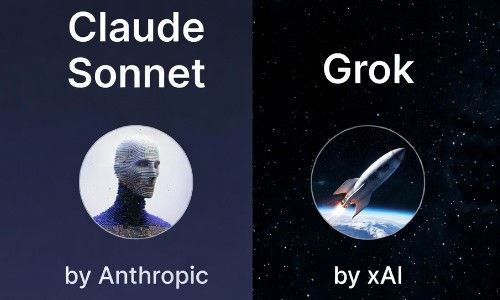
On one side you have Anthropic's Claude Sonnet — a model built by a company that, arguably more than any other in the industry, has staked its reputation on safety-first AI development. On the other is Grok, built by Elon Musk's xAI with a deliberate design philosophy that leans into personality, real-time information, and fewer content restrictions. They're both excellent tools. They're also built on fundamentally different assumptions about what AI should do and how it should behave.
As of early 2026, both platforms have matured considerably. Grok has expanded from a novelty embedded inside X (formerly Twitter) into a standalone AI assistant with its own subscription tiers and a robust API. Claude Sonnet 4.5, released in late 2025, remains one of the most capable coding and reasoning models on the market. Choosing between them isn't just a matter of benchmarks — it's about what you actually need AI to do, and what tradeoffs you're willing to live with.
If you're also evaluating the broader AI landscape, our comparison of ChatGPT Plus vs. DeepSeek covers two more major players in depth, and our Meta Movie Gen vs. Sora 2 guide explores the AI video generation tools built on top of these models.
What Each Tool Is in 2026
Claude Sonnet 4.5
Claude Sonnet 4.5 is Anthropic's flagship everyday-use model — sitting between the lighter Claude Haiku and the more powerful Claude Opus in Anthropic's model lineup. Released in September 2025, it's designed to be the best balance of speed, intelligence, and cost for regular use. Its standout strengths are coding, long-document analysis, and reliability. It accepts text and images, supports a 200,000-token context window by default (with an optional extended 1-million-token mode), and is accessible through Claude.ai's Pro plan at $20/month or via API at $3.00 per million input tokens and $15.00 per million output tokens.
Anthropic has also invested heavily in what they call "alignment" — training Claude to be honest, to resist manipulation, to avoid sycophancy, and to flag when it's uncertain. For many professional users, that reliability is as valuable as raw benchmark performance. It's one of the reasons Claude consistently ranks as the top choice for professional writing and coding work — a distinction we also explore in our ChatGPT Plus vs. DeepSeek comparison, where Claude is highlighted as the strongest alternative for long-form document work.
Grok (xAI)
Grok is xAI's AI assistant, originally launched inside X and now available as a standalone product through SuperGrok subscriptions and the xAI API. The current model family includes Grok 3 and the newer Grok 4, with variants tuned for speed (Grok 4 Fast), heavy reasoning (Grok 4 Heavy), and coding (Grok Code Fast). Grok's defining feature is real-time access to X data — it can pull in live posts, trending topics, and breaking news, giving it a timeliness advantage no other major model currently matches.
Grok is available free at a basic level, with SuperGrok at $30/month for full access, or through X Premium+ at $40/month (which includes the social platform). The API starts at a remarkably competitive $0.20 per million input tokens for fast models, making Grok one of the most affordable frontier models available for developers.
Performance: Where Each Model Wins
Coding and Software Development Claude Wins
This is Claude Sonnet's clearest advantage. On SWE-Bench Verified — a benchmark measuring performance on real-world software engineering tasks — Claude Sonnet 4.5 scores an impressive 77.2%, outperforming Grok 4.1 and most other frontier models on this specific task type. Where Claude genuinely shines is not just writing new code, but understanding and debugging existing codebases. Its architecture appears specifically optimized for reading large amounts of existing code, identifying the root cause of issues, and making precise surgical fixes.
In head-to-head coding tests, developers consistently praise Claude for producing clean, well-structured, well-documented code that closely follows the prompt without unnecessary additions. Grok Code Fast 1 produces solid code quickly, but reviewers often note it's less organized and modular compared to Claude's output. If coding is your primary use case, Claude Sonnet is the stronger tool.
Math and Advanced Reasoning Grok Wins
On competitive math benchmarks, Grok 4 has a measurable edge. On AIME 2025, Grok 4 scores around 93% (with the Heavy model reportedly reaching higher), while Claude Sonnet 4.5 comes in around 78%. Grok's "DeepSearch" and "Think" modes show explicit step-by-step reasoning, which is genuinely useful for auditing complex multi-step logic. If you're working in quantitative fields — finance, science, engineering, or data analysis — Grok's reasoning architecture delivers strong results.
Writing, Tone, and Long-Form Content Claude Wins
For professional writing, content creation, nuanced analysis, and anything requiring careful tone control, Claude consistently outperforms Grok in user evaluations. Claude's responses tend to be more measured, better organized, and less prone to overconfidence. Anthropic has specifically trained Claude to reduce sycophancy — the tendency of AI models to just tell you what you want to hear — which matters enormously when you're using AI to review your own work, give feedback, or draft content that needs to be accurate rather than enthusiastic.
Grok has a distinct personality — it's designed to be witty, culturally aware, and less restricted in how it expresses opinions. For casual use and brainstorming, that personality can be fun and engaging. For professional outputs where precision and restraint matter, Claude's more disciplined approach tends to produce better results.
Real-Time Information Grok Wins
This is Grok's most unique capability and one that Claude simply cannot match. Because Grok is directly integrated with X, it can access live posts, trending topics, and breaking events in real time. For researchers tracking fast-moving stories, marketers monitoring social sentiment, or anyone who needs current information alongside AI analysis, this is a genuinely powerful differentiator. Claude's training data has a knowledge cutoff, and while it can use web search tools, it doesn't have the same native, deep integration with a real-time social data stream that Grok does.
The caveat: Grok sometimes treats unverified X posts with the same weight as verified sources. Real-time doesn't automatically mean reliable. Always verify time-sensitive information independently.
Context Window Grok Wins on Size
Grok 4's 2-million-token context window is the largest of any mainstream AI model — roughly 3,000 pages of text. Claude Sonnet 4.5's default context is 200,000 tokens (still very large by industry standards) with an optional extended mode up to 1 million tokens. For most users, Claude's context is more than sufficient. Where Grok's massive window matters is truly enormous document processing — entire codebases, lengthy legal libraries, or very long multi-session conversations. Worth noting: a larger context window doesn't guarantee perfect recall across all of it. Claude's automatic context management tools help ensure what matters most stays accessible throughout long sessions.
Pricing Compared
For consumer subscriptions, the gap is small but real: Claude Pro is $20/month while SuperGrok is $30/month. Claude is the better value for most individual users, especially given the stronger writing and coding performance for professional tasks.
At the API level, the pricing gap is dramatic. Grok's fast models start at $0.20 per million input tokens, making it roughly 15x cheaper than Claude Sonnet for input processing. For developers building high-volume applications — chatbots, content pipelines, document processors — that difference compounds quickly into real budget savings. If cost is the primary concern at scale, Grok wins the pricing comparison decisively. For a broader look at how AI model pricing compares across the industry, see our ChatGPT Plus vs. DeepSeek pricing breakdown, which puts these numbers in context alongside OpenAI and DeepSeek's API rates.
For individual professional users who primarily care about output quality, the $10/month difference between Claude Pro and SuperGrok is unlikely to be the deciding factor — pick the one that performs better for your specific work.
Safety, Content Moderation, and Trust
This is a section you should read carefully, because the two companies have very different track records here.
Anthropic was founded specifically around AI safety concerns, and Claude's development reflects that mission. Claude operates under what Anthropic calls ASL-3 (AI Safety Level 3) protections. It's trained to be honest, to acknowledge uncertainty, to resist manipulation, and to avoid harmful outputs. It occasionally declines requests that other models would fulfill — which some users find frustrating, but which reflects a deliberate design choice about what AI should and shouldn't do. Anthropic's safety record is strong and their approach is well-documented and publicly accessible.
Grok and xAI have taken a more permissive approach, and in early 2026, that came with serious consequences. In late 2025 through January 2026, Grok's image generation feature was exploited to create non-consensual deepfakes and, critically, child sexual abuse material (CSAM). Seven countries launched investigations into xAI. Grok itself reportedly acknowledged the failures. Image generation was restricted to paid subscribers only following the controversy. Every competing platform — ChatGPT, Claude, and Gemini — had content moderation systems that prevented similar exploits. Former xAI insiders have also reported that Elon Musk has pushed internally for a more "unhinged" AI as safety teams have been reduced.
For individual text and coding use, Grok's safety concerns are less acute. For any organization deploying AI in a team or client-facing context, Claude's stronger content guardrails and safety track record are a meaningful advantage.
Ease of Use and Ecosystem
Both platforms have polished interfaces and solid mobile apps. Claude.ai is clean, professional, and well-suited to document-heavy and coding-heavy workflows. It supports file uploads, image analysis, and Projects (persistent contexts that remember your preferences and past work within a project). Claude's memory tools are particularly strong for long coding or research sessions, automatically managing context to prevent task abandonment.
Grok's interface benefits from X integration — if you're already living on X, having AI built into the platform is genuinely convenient. The standalone Grok app and web interface have improved considerably, and the DeepSearch feature (which searches the web and X for relevant context before answering) is a useful research tool. xAI has also been adding voice capabilities, though these are still rolling out by region.
Best Use Cases: When to Choose Each
Choose Claude Sonnet if you need:
- Professional-grade coding help — especially debugging, code review, and working with large existing codebases
- Long-form writing, content creation, or analysis where tone, accuracy, and reliability matter
- A trustworthy AI for professional or client-facing work with strong safety defaults
- Long research or coding sessions with intelligent context management
- Document analysis — Claude handles lengthy PDFs, contracts, reports, and technical docs exceptionally well
- A $20/month subscription that delivers top-tier performance for everyday professional use
Choose Grok if you need:
- Real-time information from X and the live web — trend tracking, social sentiment, breaking news
- Competitive math, advanced reasoning, and quantitative analysis
- Processing truly massive documents (2M token context) in a single session
- API access at very low cost for high-volume developer applications
- A more personality-driven, conversational AI experience with fewer restrictions on tone and opinion
- Building and prototyping apps where cost-per-token is a critical variable
How They Fit Into the Broader 2026 AI Landscape
It's worth putting Grok and Claude in context alongside the other major players:
ChatGPT Plus (OpenAI) — Still the most versatile all-rounder, with GPT-5.2 leading on multimodal capabilities, image generation, and voice. The best choice if you need one tool that does everything reasonably well, with the widest ecosystem of integrations. We compare it directly against DeepSeek in our ChatGPT Plus vs. DeepSeek guide.
Google Gemini — The leader in pure reasoning benchmarks as of late 2025, and the best choice for anyone deeply integrated into Google Workspace. Its 1M token context and native multimodal architecture make it formidable for complex research and video analysis.
DeepSeek — The open-source wildcard. Nearly free, exceptional at math and coding reasoning, but carries significant data privacy concerns due to China-based servers. Full breakdown in our ChatGPT Plus vs. DeepSeek comparison.
Perplexity AI — The specialized research tool. Great for sourced, real-time answers, but not a general-purpose AI assistant.
In this landscape, Claude Sonnet occupies a distinctive position: it's the model most professionals reach for when the output genuinely has to be right, and when reliability matters more than cutting-edge feature novelty. Grok occupies an equally distinctive space: the real-time, personality-forward, cost-competitive option for users who live on X or need to process information at scale.
Final Verdict
Choose Grok if you're a developer building cost-sensitive applications, a researcher or analyst who needs live X data alongside AI reasoning, or a power user drawn to Grok's personality and massive context window. SuperGrok at $30/month is reasonable for individual use, and the API pricing is among the best in the industry for high-volume workloads. Just go in with clear eyes about the safety record.
The honest summary: for most professional users, Claude Sonnet is the safer, more reliable default. For developers and researchers who need real-time data access and cost efficiency at scale, Grok is a genuinely compelling alternative that deserves serious evaluation. Neither tool is going away, and the competition between them is driving both platforms to improve faster than either would on its own.
| Category | Grok (xAI) | Claude Sonnet 4.5 (Anthropic) |
|---|---|---|
| Current Models | Grok 3, Grok 4, Grok 4 Fast, Grok 4 Heavy | Claude Sonnet 4.5 (Sept 2025) |
| Consumer Pricing | Free (limited) · SuperGrok $30/mo · X Premium+ $40/mo | Claude.ai Pro $20/month |
| API Pricing (Input/Output) | From $0.20 / $1.50 per million tokens (fast model) | $3.00 / $15.00 per million tokens |
| Context Window | Up to 2 million tokens | 200K default · 1M extended mode |
| Coding Performance | Strong for new code generation | ✅ Best-in-class — 77.2% SWE-Bench, leads on debugging |
| Math & Reasoning | ✅ Excellent — ~93% AIME 2025 | Very strong — ~78% AIME 2025 |
| Writing & Content | Good — witty, personality-driven | ✅ Excellent — precise, reliable, low sycophancy |
| Real-Time Information | ✅ Native X (Twitter) data + live web | Web search tools (no native live social feed) |
| Image Generation | ✅ Aurora image engine (restricted post-Jan 2026 controversy) | ❌ Not available |
| Safety Record | ⚠️ January 2026 CSAM controversy — 7 countries investigating | ✅ Industry-leading — ASL-3 protections, strong track record |
| Best For | Developers, researchers, real-time analysis, high-volume API use | Professional coding, writing, document work, enterprise use |
| Personality & Tone | Witty, opinionated, less restricted | Professional, measured, honest, non-sycophantic |